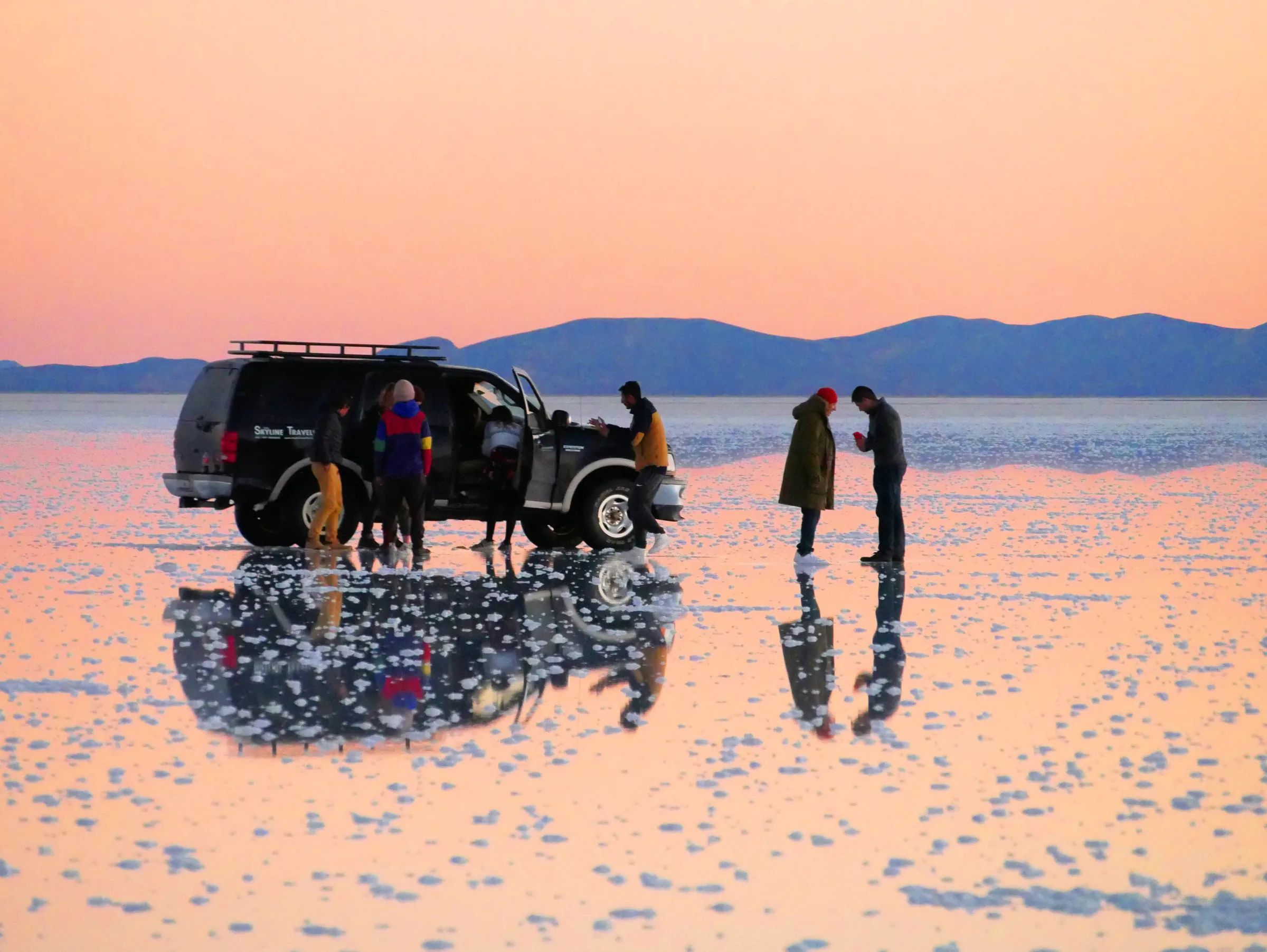
Salar de Uyuni, Bolivia

A white salt plain stretches toward the mountains. After rain, shallow water can turn parts of it into a reflection of the sky. Salar de Uyuni is remarkable in either season, but the trip you plan will shape what you experience. Compare the landscapes, allow for the altitude, and see how the salt flats fit into a longer journey through Peru and Bolivia.

Things to Do in and Around Uyuni

Begin with the salar itself. The places below offer different experiences, from stops near town to remote landscapes that need their own travel days. They are possibilities to plan around, not a list of inclusions in every package.

Explore the Dry Salt Flats

Explore the Dry Salt Flats

See the texture of the salt crust and experiment with perspective photographs against the open horizon. A 4x4 outing covers the distances between stops, with time outside the vehicle to take in the landscape. The route follows the conditions on the ground.
Look for the Mirror Effect

Look for the Mirror Effect

When shallow water and calm conditions align, reflections can blur the boundary between salt and sky. Leave time to enjoy the changing light, without making one photograph the measure of the whole trip. A rainy-season date alone cannot promise the effect.
Visit Isla Incahuasi When Accessible

Visit Isla Incahuasi When Accessible

Cacti and rocky paths give this island a different perspective on the surrounding salt flat. Walking here involves uneven ground at altitude. Flooding can prevent access, so treat Incahuasi as a condition-dependent stop, not a guaranteed feature of a wet-season visit.
Discover Uyuni Beyond the Salt Flats

Discover Uyuni Beyond the Salt Flats

Uyuni town is a practical starting point for the region. Nearby, the train cemetery recalls its railway history, while Colchani adds a look at local salt production and crafts. Discuss which stops suit your interests and schedule; they do not need to fill an entire sightseeing day.
Continue to Laguna Colorada

Continue to Laguna Colorada

Farther south, Laguna Colorada brings red-toned water, mountain scenery, and the possibility of seeing flamingos. This belongs to a longer Altiplano circuit, with rougher drives, higher elevations, and remote overnight stops. Choose it for the wider journey, rather than treating it as a quick addition to the salar.
Consider an Evening Under the Stars

Consider an Evening Under the Stars

A night outing can offer another view of the salt flats when skies are clear. Moonlight, cloud cover, access, and cold all affect the experience. Stargazing is an optional activity to confirm separately; photographs of a vivid Milky Way do not represent what every visitor will see with the naked eye.

Planning Your Salar de Uyuni Visit

Dry Season or Mirror Season?

May through October generally favors dry salt landscapes and travel across more of the salar. The colder months can bring very cold nights, particularly on higher routes. Dry season does not guarantee every road or viewpoint will be accessible. December through March is the usual window to consider if reflections are your priority. Rain supplies the water, but its depth, wind, and light determine the effect. Flooding can restrict crossings and access to Incahuasi. April and November are transition periods, not a promise of both landscapes in one visit.

How Many Days Should You Allow?

One full sightseeing day can focus on the salar and selected nearby stops. Two sightseeing days give more room for photography, a slower pace, or weather-related changes. Neither option automatically includes the southern lagoons. A circuit extending to Laguna Colorada and farther south usually needs three or more touring days, depending on the route, overnight stops, and end point. Count arrival and departure time separately. Three hotel nights do not necessarily provide three full sightseeing days, and adding nights cannot guarantee mirror conditions.

Getting There and Connecting Onward

PWP's published Peru and Bolivia itineraries route through La Paz and include flights to and from Uyuni in their travel plans. Actual schedules and ticket inclusions must be checked for your dates. An early arrival may allow sightseeing; a delayed flight may change that plan. Overland travel is another way to reach Uyuni, but it adds substantial time on the road. Within the region, check daily driving time, rest stops, and your overnight location. Allow a buffer before an important onward flight, especially when combining countries.

Altitude and Comfort Shape the Route

The salar lies at about 12,000 feet (3,650 meters), and southern circuits reach higher elevations. Plan time to acclimatize and discuss the route with a healthcare professional, including where you will sleep. A journey through Cusco or La Paz does not guarantee that everyone will adjust equally well. Before adding remote nights, confirm the specific lodging, heating, bathroom arrangements, meals, vehicle setup, and guide language. Private transport can give your group more control over stops; it cannot remove the altitude, rough roads, or limits of remote accommodation.

Travel Packages That Include Uyuni

The 14-day Peru and Bolivia itinerary leaves room to shape a second day around Uyuni. The 20-day journey adds Buenos Aires; the 21-day route begins in the Galapagos. Both longer routes include Laguna Colorada and a remote overnight in their published plans. Compare the driving demands, lodging, and flight inclusions before choosing your route. Flights shown in an itinerary are not necessarily included in its price. Check the package details and your final quotation.

Why Travel with Peru Wayna Picchu?

Why Travel with Peru Wayna Picchu?

Tailor-Made Travel

Every trip is personally designed around your interests, pace, and style by our specialists.

Why Travel with Peru Wayna Picchu?

Exclusive Access

Private or small-group travel, maximizing your time and budget.

Why Travel with Peru Wayna Picchu?

Expert Local Guides

Handpicked professionals who make every trip insightful and unforgettable.

Why Travel with Peru Wayna Picchu?

Trusted Peru Travel Expertise

10+ years of experience, 24/7 support, and official recognition for seamless travel.

Added peace of mind! Postpone your trip at no cost up to 20 days prior to departure No change fee with open dates.

Local Operational Flexibility

Added peace of mind! Postpone your trip at no cost up to 20 days prior to departure No change fee with open dates.

See more

Frequently Asked Questions About Visiting Salar de Uyuni

It may be possible, but the two depend on different conditions. Shallow water creates reflections, while deeper flooding can prevent reaching Incahuasi. Share your priorities when planning, and be prepared for the day's route to change. Neither stop should be promised solely from your travel month.

Consider each child's health, comfort with long drives, and response to altitude. Children can experience altitude illness too; discuss the itinerary with their healthcare professional. Before committing, check vehicle restraints, bathroom stops, room arrangements, and access to medical help. A salt-flat-focused stay and a remote southern circuit have different demands.

Decide whether your priority is photography, time together on the salt flats, or a broader landscape journey. An extra visit can give you more flexibility with light and weather. Discuss early starts, evening outings, and room preferences before adding them; a private arrangement does not mean exclusive access to the landscape.

No. Time at altitude may help acclimatization, but fitness and previous high-altitude travel do not guarantee protection. Review the full sequence of daytime and sleeping elevations with a healthcare professional. If anyone feels unwell, tell the guide promptly and seek appropriate medical advice rather than continuing simply to keep the itinerary.

Bring layers, a warm jacket, a windproof outer layer, a hat, gloves, sunglasses, and sun protection. Comfortable closed shoes are useful on dry ground. For wet conditions, confirm whether suitable waterproof boots are provided and available in everyone's size. Keep essentials accessible during drives and protect electronics from water and salt.

Do not assume that a remote lodge offers the same facilities as a city hotel. Confirm heating, hot water, private bathrooms, bedding, power, and meal arrangements for each overnight stop. If those details are central to your trip, agree on the lodging before committing to the southern circuit. No specific hotel or star rating is promised by this guide.

Yes, these destinations can form part of a longer journey. Plan around international connections, time at altitude, and the number of travel days involved. The salt flats are in Bolivia, so a Peru combination also requires Bolivian entry formalities. Use the Travel Packages section to explore published itinerary ideas and check what is included.

As checked on November 6, 2026, US citizens do not need a visa for tourist stays of less than 90 days in a year; full British citizen passport holders can visit visa-free for up to 90 days in a one-year period. Both official guides specify at least six months of passport validity on arrival; UK guidance also specifies two blank pages. Recheck the US Bolivia travel guidance (travel.state.gov/en/international-travel/travel-advisories/bolivia.html) or the UK entry requirements (gov.uk/foreign-travel-advice/bolivia/entry-requirements) for your nationality and route. Confirm yellow fever certificate requirements, especially when arriving from another South American country, and any documentation for children or dual nationals. When crossing from Peru, complete the exit and entry formalities on both sides.

Check the current US travel advisory (travel.state.gov/en/international-travel/travel-advisories/bolivia.html) and UK travel advice (gov.uk/foreign-travel-advice/bolivia). At the November 6, 2026 review, the US advisory was Level 2 for Bolivia, with a Do Not Travel warning for Chapare Province. UK guidance advised against all but essential travel to Chapare and reported a State of Emergency in Bolivia. These warnings do not describe every region in the same way. Protests and roadblocks can affect wider travel plans; do not attempt to cross roadblocks. Check your full route and insurance coverage, including remote travel and medical evacuation, before departure.

No. Stargazing requires a separately confirmed outing and suitable conditions. Geysers, hot springs, and Laguna Verde belong to the farther-south circuit and can add substantial driving and higher elevations. Read the chosen package carefully: Laguna Colorada may be part of the base route even when the deeper southern extension is optional.

Photo Credits

Photograph attributions and licenses

Photo Credits

Photographs from Wikimedia Commons. Images were proportionally resized and converted to WebP; the layout crops the displayed view. Derivatives retain each source’s license. No endorsement is implied.

We can call you in 30 seconds